When “Can You Just...?” Keeps Landing on Her Post
 |
Pour your favorite sip. For the past several weeks, we have been looking at the Pressures sitting on the top layer of my DAWN Leadership Cake Framework. What is she being asked to carry? More responsibility. Repeated proof of readiness. Relational expectations. Constant availability. A narrower range of acceptable leadership behavior. And sometimes the added visibility of being one of very few women in the room. Now we move to the middle of the Cake. |
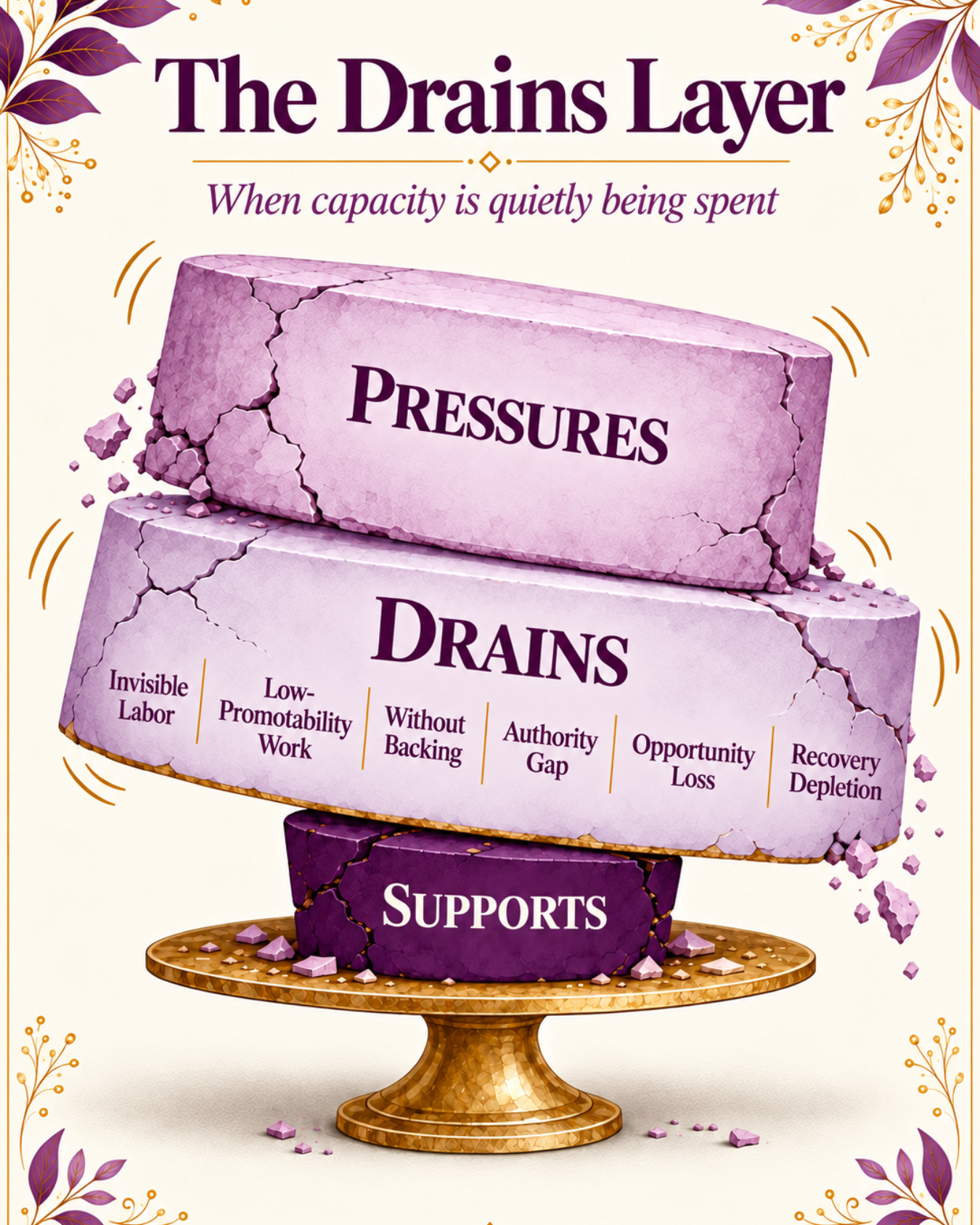 |
The Drains. Here is the simplest distinction I can make: Pressures are what the organization asks her to carry. Time. Attention. Energy. Opportunity. Credibility. Voice. Self-trust. Recovery. And one of the easiest places to see that happen often begins with four innocent words: “Can you just...?” Can you just take notes? Can you just help onboard the new person? Can you just serve on this committee? Can you just mentor her? Can you just take care of this? Nike made “Just Do It” famous. I’m not sure “Just do one more thing” has been nearly as helpful to women leaders. Each request may be small. But small things accumulate. |
We have talked about the caring. Now look at what it costs.A few weeks ago, I wrote about the relational pressure women leaders can carry: the expectation to notice, mentor, check in, repair, welcome, remember, and help hold the human side of a workplace together. That was the Pressure. This week I want to look at the other side of it. What happens to her leadership capacity and opportunity when she keeps being the person who does that work? That is the Drain. And this is where the issue becomes bigger than whether someone feels busy. |
Some necessary work does very little to build a careerEconomists Linda Babcock, Maria Recalde, Lise Vesterlund, and Laurie Weingart call these low-promotability tasks: necessary work that benefits the organization but contributes relatively little to the person’s advancement. Their American Economic Review research found that women were more likely than men to volunteer for such tasks, more likely to be asked to do them, and more likely to accept when asked. The researchers also found that expectations that women would say yes helped perpetuate the pattern. That distinction matters. This isn’t simply a story about women needing to learn to say no. If leaders repeatedly turn to the same person because she always comes through, the organization itself begins reinforcing the pattern. And I know how easy this is. I have always appreciated the person who sees something that needs doing and simply takes care of it. There can be real satisfaction in being dependable. And there is nothing wrong with being the person who cares enough to notice. But somewhere along the way: “She’s so good at this” can become the reason she keeps getting more of it. I have experienced that myself. Being capable and dependable can feel like a compliment right up until it quietly becomes the reason more keeps landing on your plate. |
The issue is not whether the work mattersIt often matters enormously. Someone should mentor the new employee. Someone should notice the struggling team member. Someone should help repair a relationship. Someone should organize the committee work that keeps things moving. A 2025 study of women principals and assistant principals is particularly interesting here. The researchers described emotional labor as instrumental to the women’s leadership while also finding gendered expectations, intensified workload, and implications for well-being. They titled the study: “Unaccounted work of women leaders.” I like that language. Unaccounted does not mean unimportant. It means the organization may benefit from the work without fully accounting for the time, energy, opportunity, recognition, or compensation required to provide it. And that brings me to the question I think leaders need to ask. |
What is this work displacing?Every role contains tasks that are not glamorous or promotable. That isn’t the problem. The leadership question is whether those tasks are being distributed in ways that quietly determine who still has enough capacity to gain the experiences the organization later rewards. Look at one list:
Now look at another:
Who is getting each list? That is where a seemingly small workload question can become a leadership-pipeline question. If one group repeatedly carries the work that keeps the organization functioning while another gets more of the work that builds visibility, operational experience, and readiness for advancement, the difference compounds over time. The organization is not only allocating work. It may also be allocating future opportunity. |
That is why this is a DrainThe Pressure may sound like: She’s great with people. Let’s ask her. Or: She’ll get it done. The Drain is what happens next. Her time goes somewhere. Her attention goes somewhere. And some other opportunity may not happen because that capacity has already been spent. The real cost of “just one more thing” may be the more consequential work she no longer has room to do. That is an organizational issue, not simply a woman’s time-management problem. |
Four things leaders can do nowNotice who gets asked. For a few weeks, pay attention to who receives the necessary-but-low-visibility assignments. You may see a pattern that was easy to miss when each request was considered separately. Compare the two kinds of work. Who is receiving the work that serves the organization today, and who is receiving the work that prepares someone to lead more of it tomorrow? Ask what comes off. When you add something to a capable person’s plate, ask: If she says yes to this, what are we intentionally allowing her to say no to? Rotate what can be rotated. If a task belongs to the team, treat it like teamwork. Do not let competence become permanent ownership. This is not about shielding women from contributing. It is about being much more intentional with leadership capacity. Questions to carry into the week
|
Your Fall Cake Resource TakeawayThis week’s Leader Takeaway begins the Drains layer of the Cake. It will help your team compare necessary work with career-building work, notice who is carrying each, and decide what should be rotated, reassigned, recognized, or removed. |
And if you missed last week’s leader resource, Who Is in the Room—and Who Can Shape What Happens There?you can download it here. This resource will help teams examine whether constant availability has quietly become part of their leadership standard. |
Before you finish your morning cupI don’t want women to care less. I don’t want people to stop noticing what needs to be done. I do want organizations to become much more thoughtful about where their strongest people’s capacity is going. Because “Can you just...?” may sound like a tiny request. But if it keeps landing on the same person, the more important question becomes: What opportunity might she be giving up when we keep spending her time this way? Warmly, |
Research NotesBabcock, L., Recalde, M. P., Vesterlund, L., & Weingart, L. (2017). Gender Differences in Accepting and Receiving Requests for Tasks with Low Promotability. American Economic Review, 107(3), 714–747. Women were more likely to volunteer for low-promotability tasks, be asked to volunteer, and accept such requests; the authors note that these task-allocation differences can contribute to slower organizational advancement. Hollweck, T., Everitt, L. M., & Kendrick, A. H. (2025). Unaccounted work of women leaders – the experience and impact of providing emotional labour on women leaders. Journal of Educational Administration, 64(2), 161–174. The qualitative study of women school leaders found emotional labor was seen as instrumental to the work while also involving gendered expectations, workload intensification, and implications for well-being. |


