Baseball, Politics and Women
Pour your favorite sip. I love baseball. My Yoder family and the World Series of 1968 probably solidified that. |
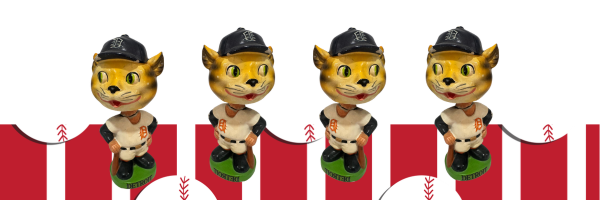 |
When those Detroit Tigers were in the World Series, my dad bought me a Tigers bobblehead at the stadium when he got to attend a game. I still keep it on my desk today, broken neck and all. My Grandpa Chet was an umpire. My dad and Uncle Clair played ball, and my aunts played softball. I spent a lot of childhood time around the Emerson Park diamonds in Midland, Michigan. During that 1968 World Series, my baseball-loving grandpa had a breezeway, and he practically wallpapered it with newspaper pictures and articles about Mickey Lolich, Denny McLain, Bill Freehan, Al Kaline, Willie Horton, Norm Cash, and that team. I can still see it. Maybe that is part of why baseball has always felt like more than a game to me. |
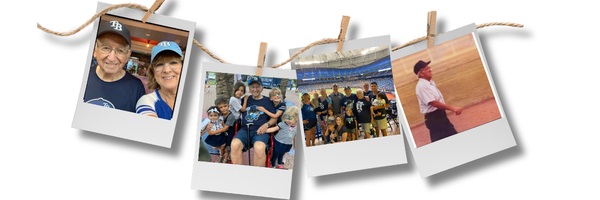 |
It was also the setting for the last truly fun outing we had with my dad before he died. We delighted him with a Jumbotron message at a Rays game: Happy 86th Birthday, Denny! The Rays had long since become his adopted next-best team. Last week, Doug and I were at a Rays playoff game with family members, yelling and cheering and thoroughly enjoying a win. Monday night, Doug was there again when Tampa Bay won the American League pennant in Game 6. The rest of us watched from home and blew up one another’s phones with nonstop commentary about this pitch, that hit, and every moment in between. And oh, the joy after Junior Caminero’s two-run homer and then Yandy Díaz’s two-run shot. Junior took 38.66 seconds to enjoy his home-run trot, pounding his chest, soaking in the crowd, and then doing his version of former Rays favorite Randy Arozarena’s signature pose after spotting Randy in the stands. It was pure delight.MLB.com Not managed joy. Not I hope I look appropriately professional on television joy. Just glorious, unabashed, we-actually-did-it joy. They jumped on one another, yelled, pointed, grinned, and ran toward one another with big hug bear hugs. And now the Tampa Bay Rays are going to the World Series (clap, holler, hoot!). They got there by beating Cleveland in six games for the American League pennant, and now they meet Milwaukee in a World Series that will produce a first-time champion. Even more fun for those of us who love an underdog: both Tampa Bay and Milwaukee rank in the lower half of Major League Baseball payrolls this year. AP News One or two World Series games will be in the books by the time you read this. Ooh, I can’t wait to know who’s won by then. |
 |
Maybe I need the little team to winI have been thinking about why this delights me so much. Maybe I simply love a good David-and-Goliath story. But I think there is something else. Maybe I want to believe the little guy can win because I want that to be true for women, too. I want to believe extraordinary talent can rise even when the resources, access, networks, and advantages surrounding it are not equal. Baseball makes that easy to see. The Yankees can spend vastly more than the Rays. Bigger payrolls can buy proven players, depth, options, and room for expensive mistakes. Money matters. Of course it does. But then the teams have to play. The smaller-budget club still has to pitch, hit, develop talent, make smart decisions, recover from mistakes, and believe it belongs on the same field. And every once in a while, the little team looks across at the giant and says: Let’s play anyway. I love that. |
But even the underdog has a dugoutHere is where the analogy became more interesting to me. Those Rays players may play for a lower-payroll organization, but nobody sends a young player onto the field and says: Good luck. Just believe in yourself. He has coaches. People study his swing. Someone works on his mechanics. Someone tells him what they are seeing. He strikes out and returns to teammates who still expect him to take another at-bat. Junior Caminero had gone through this postseason without a home run until that seventh-inning swing Monday night. Then suddenly, on the biggest stage yet, there it was.MLB.com And Taylor Walls is another example. His bat has not been the story of this postseason, but his defense has mattered. Teams know how to keep seeing the whole player, not merely the most recent statistic. That may be part of what a real team does. The underdog may have fewer resources. But he is not expected to become his own entire support system. Junior Caminero is a particularly striking example of the financial contrast. FanGraphs lists his 2026 salary at about $795,000, while Aaron Judge is at $40 million. And Ohtani? Depending how one calculates he's like twice as much as Judge even. Whew! The Rays’ entire estimated payroll is about $87 million. FanGraphs Baseball No one would call Caminero untalented because he earns less. And that made me think about women. |
What if “believe in yourself” is not enough?We have spent years telling women to speak up, be confident, take the risk, advocate for themselves, negotiate, ask for the assignment, own their ambition, find the mentor, and build the network. All useful advice. I coach women around some of those very things. But I wonder whether we sometimes underestimate how difficult it is to manufacture self-belief when years of experience have also taught many girls and women to monitor themselves carefully. Be nice. Don’t brag. Don’t be bossy. Don’t take up too much room. Help. Include. Get it right. Don’t make someone else uncomfortable. And then somewhere along the way we turn to those same women and say: Be bold. Be visible. Take the risk. Speak with authority. Trust yourself. Wowza. That is quite a pivot. Of course women can do it. Women do it every day. But perhaps what we sometimes call a confidence problem has a longer history than we realize. Years of learning to check yourself do not simply disappear when someone gives you a leadership title. |
And then there is influenceMaybe that is why another current event has been bumping around in my head this week. We are approaching a national election, and enormous amounts of money are being spent trying to influence what people hear, notice, and ultimately choose. Super PACs can accept unlimited contributions for independent political spending. They cannot cast our ballots for us, but money can certainly amplify a message and increase its reach. It does leave me wondering about something bigger than politics: Who has the resources to amplify their influence? Money can amplify a political message. A large payroll can create options in baseball, but as this postseason has shown, it does not guarantee a trip to the World Series. Organizations have their own forms of influence, too: titles, budgets, relationships, networks, and the people everyone listens to even when the org chart does not explain why. There is the executive who says, “Have we considered her?” There is the person whose idea gets another five minutes of discussion rather than being passed over. Power and influence are not quite the same thing. But access to power can certainly make influence easier to exercise. |
Maybe this is what moved me mostWatching those Rays celebrate, I kept coming back to how freely they seemed to want it. They wanted to win, and they were not embarrassed by wanting to win. When somebody else succeeded, they ran toward him. There was no apparent concern that celebrating his home run somehow diminished their own contribution. They knew how to root for one another because that is what teams do. And I found myself wondering: What would change if more women experienced another woman’s win not as evidence that there is now one fewer seat available, but as evidence that women belong there? What if women did not have to generate all of the belief themselves? What if someone was studying their strengths, putting them back in after a miss—or after 11 misses—calling out what they could become, opening the door, and rooting loudly when they succeeded? Maybe I have been drawn to the little team because I need to believe that talent can overcome an uneven field. But I don’t want to romanticize the uneven field either. Talented people should not have to overcome unnecessarily poor conditions just to prove how talented they are. That may be the piece we miss when we celebrate the underdog. The Rays’ story is remarkable because they have accomplished so much with fewer financial resources. Our leadership goal should not be to create workplaces where women have to do the same. It should make us wonder: What might talented women do if we put enough behind them? |
Questions to carry into the week
A different kind of resource this weekI’m giving the Leadership Cake a one-week breather. Instead, with Christmas not so far away, I have been thinking about a very different kind of gift. What if you gave someone a better understanding of themselves — and of the people they love? I’m offering a special holiday opportunity for Integrative Enneagram assessments and personal debriefs for couples, adult children, family members, or even the executive who truly does not need another thing. It can be practical, meaningful, and honestly pretty fun. More on that below. |
Before you finish your morning cupMaybe the little girl with the Tigers bobblehead never stopped loving the idea that the game is not decided until somebody plays it. And maybe the woman I have become wants to believe that just as fiercely for women: that the size of the budget is not the size of the talent; that access is not the same thing as ability; that confidence is easier to sustain when somebody else believes you belong, too—and believes you will absolutely hit the next one; and that when one of us gets the big hit, the rest of us can run toward her and celebrate without reservation. Maybe the little team does not need to pretend the odds are equal. Maybe it needs enough people in the dugout who believe it can win anyway. Go Rays. And Brewers since you’re one of the little guys, too—happy to play you. Warmly, |


